




dPCRDigital PCR Services for Precise, Absolute Nucleic Acid Quantification

Detect low-abundance targets, measure copy number and quantify DNA or RNA with partition-based digital PCR. SCD supports assay feasibility, tailored method development, validation and sample testing for discovery studies and drug development programs.

GLP accredited by SWEDAC.

Request a QuoteBook a Scientific Consultation

DPCR precise scientists
Trusted By
Quality assurance & compliance

We are accredited for Good Laboratory Practice (GLP) by the Swedish Board for Accreditation and Conformity Assessment (SWEDAC) for qPCR, dPCR, and molecular biology.

About dPCR

Digital PCR at SCD

When a small molecular signal matters, choosing the right measurement approach is critical. Digital PCR (dPCR) separates a sample into thousands of individual reactions and counts target-positive and target-negative partitions to calculate nucleic acid concentration. This approach offers absolute quantification without routinely relying on a conventional standard curve and can be especially useful for rare targets, subtle copy-number differences and challenging sample matrices.

At SCD, our Gothenburg-based molecular bioanalysis specialists work with customers to establish dPCR methods suited to the analyte, specimen and decision the results must support. Services range from exploratory assay assessment to documented validation and testing within an agreed quality framework.

Specifications

dPCR Specifications & Technical Capabilities

The precise assay range, sample requirements and regulatory scope are established during project scoping.

Technology Partition-based digital Polymerase Chain Reaction (dPCR)
Measurement Absolute target quantification based on positive/negative partition counts and statistical correction
Analytes DNA and RNA targets; RNA analysis requires an appropriate reverse-transcription workflow
Typical applications Vector copy number, rare-variant detection, cfDNA analysis, biomarker measurement and residual nucleic acid testing
Sample inputs Extracted nucleic acids from tissues, biofluids and other matrices, subject to feasibility assessment
Assay formats Targeted singleplex and multiplex assays
Assay development Target selection, primer/probe evaluation, partition optimization and matrix assessment
Quality assessment Specificity, precision, sensitivity, quantifiable range, inhibition, , as appropriate
Platform / throughput Platform, partition format and sample capacity to be confirmed with the Gothenburg laboratory
Quality framework Research, qualified or validated workflows; GLP/GCLP applicability assessed for each study
Outputs Target concentration and supporting QC/analysis documentation; validation reports
Assay development

Custom dPCR Assay Development & Validation

Reliable digital measurements begin well before a sample enters the instrument. We assess the target sequence, sample matrix and expected abundance to determine whether dPCR can answer the research or bioanalytical question with the necessary confidence.

  • Assay feasibility: evaluate target accessibility, background signal, expected concentration and suitable controls.
  • Primer and probe optimization: establish specific target discrimination and robust positive/negative partition separation.
  • Sample preparation: evaluate extraction recovery, nucleic acid integrity and potential matrix inhibition.
  • Analytical performance: characterize precision and accuracy specificity, sensitivity limit, quantifiable range and robustness according to intended use.
  • Method qualification or validation: document predefined acceptance criteria and reporting requirements appropriate to the project.

Need a custom-developed or validated molecular assay? Explore Method Development & Validation.

Quality control

Quality Control for Trustworthy dPCR Results

Digital PCR removes dependence on calibration curves for absolute-quantification measurements, but it does not remove experimental variability. Sample preparation, partition formation, assay specificity and data interpretation all influence the result. SCD applies controls selected for the assay and its intended use.

  • Extraction and process controls to assess sample recovery and workflow performance where relevant.
  • No-template and other negative controls to identify contamination or nonspecific signal.
  • Positive controls and reference materials to verify target detection and assay behavior.
  • Partition-quality and occupancy checks to assess valid reaction counts, saturation and separation of positive and negative populations.
  • Replicates and Quality-Control samples to assess variability, inhibition and run suitability against predefined criteria.
  • Instrument, reagent and sample-stability checks in accordance with the agreed quality system.

For regulated or validated studies, the applicable QC limits, acceptance criteria and reporting practices are established in the study-specific method; they should not be assumed to be universal across dPCR assays.

dPCR workflow

From Study Question to Quantitative Results

Analytical objective
Feasibility &
assay design
Measurement
Results &
reporting
Person having online consultation
Step 1

1. Define the analytical objective

We review the biological target, sample origin, number of specimens, expected target abundance, required reporting units and study stage.

SORT-seq and VASA-seq cell capture plates move through a pipetting robot
Step 2

2. Establish feasibility and assay design

Our scientists evaluate extraction requirements, partition strategy, primer/probe design, control materials and whether dPCR is the most suitable method.

Single Cell Discoveries lab
Step 3

3. Generate and review measurements

Samples are processed using the agreed procedure. Partition data, control outcomes and assay-specific acceptance criteria are assessed before results are accepted.

Person loading Illumina NextSeq2000
Step 4

4. Deliver results and interpretation context

We provide quantitative findings together with the agreed QC information, methodology and, where applicable, qualification or validation documentation.

Applications

Where Digital PCR Adds Value

  • Cell and gene therapy: quantify vector genomes, assess vector copy number and support biodistribution or shedding studies where appropriate.
  • Liquid biopsy and cfDNA: investigate low-abundance molecular targets in cell-free DNA, subject to assay sensitivity and matrix suitability.
  • Biomarker research: measure selected DNA or RNA markers and track molecular changes across sample sets.
  • Copy-number studies: resolve differences in target abundance relative to suitable reference loci.
  • Residual nucleic acid testing: support targeted measurements of process-related or other residual DNA where the method is fit for purpose.
  • RNA therapeutics: develop target-specific assays for relevant RNA species using an appropriate RT-dPCR workflow.
Our expertise

dPCR Expertise Rooted in Gothenburg

Formerly TATAA Biocenter

SCD’s digital PCR services are supported by our laboratories in Gothenburg, Sweden, formerly operating as TATAA Biocenter, now TATAA, an SCD company. The team brings established expertise in molecular assay development, measurement quality, and validation into SCD’s broader discovery-to-validation offering.

Scientists from TATAA contributed to the original MIQE guidelines for qPCR and to the digital PCR reporting recommendations known as dMIQE. These publications emphasize transparent experimental design, adequate controls and reproducible reporting. In 2024, TATAA also contributed to an industry-authored AAPS publication on developing and validating qPCR and dPCR assays for cell and gene therapy drug development.

Together with SCD’s sequencing, single-cell, and spatial capabilities in the Netherlands, this expertise helps customers connect exploratory molecular findings with focused quantitative follow-up studies. The regulatory framework and accredited scope are confirmed for each project.

~20,000
Droplets per reaction

96
Samples per plate

0
Conventional standard curves needed

How it works

How Does Digital PCR Work?

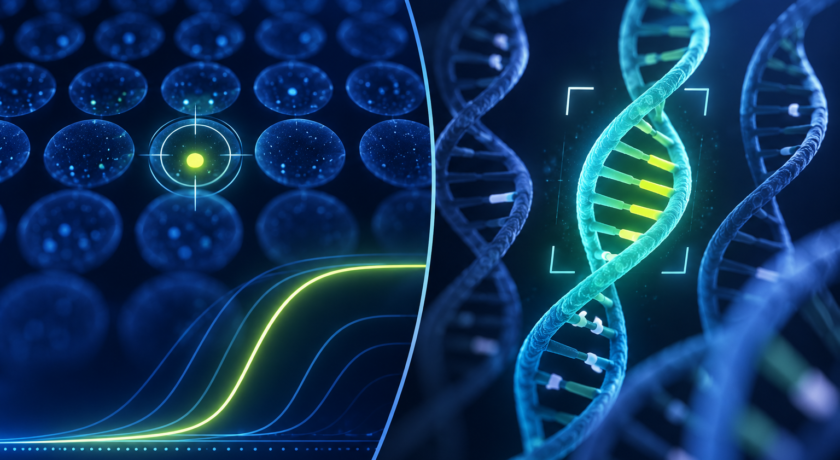
In dPCR, a prepared reaction mixture is distributed across a large number of small partitions. Following amplification, each partition is classified as positive or negative for the target. The fraction of positive partitions is used with a statistical model, commonly based on Poisson distribution, to estimate how many target molecules were present in the starting reaction.

Because the result is derived from partition counts, dPCR can report absolute concentration without constructing a conventional calibration curve for every assay. Accurate interpretation still requires attention to partition volume, target occupancy, sample dilution, assay specificity and the uncertainty of the measurement.

Comparison

qPCR vs. dPCR: Which Technology Fits Your Study?

qPCR Measures fluorescence during amplification and uses Cq values; commonly supports relative expression analysis and standard-curve-based absolute quantification.
dPCR Counts target-positive partitions after amplification to estimate absolute concentration; useful when precise copy-number measurement or low-abundance target detection is important.
Choosing between them Consider target abundance, required sensitivity, precision, throughput, cost, sample matrix and the intended regulatory use. Neither approach is universally superior.

Comparing approaches? Explore our qPCR Services or speak with our scientists about the right analytical strategy.

Wondering if this service can
help answer your biological question?

Request a quote today and find out how our expertise can support your research.

Request quotation

What our clients say

Prof. Dr. Stella Autenrieth, Research Group Leader at German Cancer Research Center

"The service of Single Cell Discoveries guarantees a smooth process between customer and company. In case of problems or questions, the scientists reacted competently and immediately, so that answers could be found quickly and flexibly."

Samuel García Pérez, Principal Investigator at Galicia Sur Health Research Institute

"Fantastic job made by a really professional and friendly team. I strongly recommend Single Cell Discoveries for sequencing services."

Recent publications using dPCR

No publications in this category. Perhaps searching can help.

Case studies

Recent blogs related to dPCR

Frequently Asked Questions
Does digital PCR need a standard curve?

Not typically for absolute quantification: target concentration is estimated from the proportion of positive partitions. Reference materials, controls and verification of measurement performance are still essential.

Request a quote

Discuss Your Digital PCR Project

Whether you are developing a new assay or need targeted quantification for an ongoing program, our molecular biology specialists can help define the right measurement strategy. Tell us about your analyte, samples and study objectives, and we will discuss feasibility, method requirements and next steps.

REQUEST A QUOTEBook a Call

Your details - Step 1 of 2