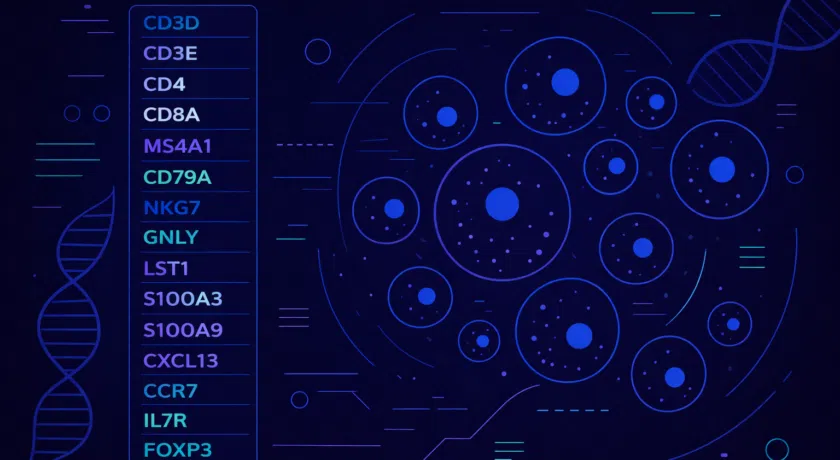
Why a list of genes is not a cell type
Single-cell sequencing is one of the most powerful discovery tools in biology. In a single experiment, you resolve full transcriptomes across every major and minor cell type in your tissue….
Discover the world of single-cell sequencing through our knowledge blogs. Explore essential information, gain valuable insights, and expand your understanding of single-cell sequencing.
Single-cell sequencing is one of the most powerful discovery tools in biology. In a single experiment, you resolve full transcriptomes across every major and minor cell type in your tissue….
There is one question that should precede almost every other decision in single-cell experiment design: “what is the rarest cell population I really care about?” Not which platform to use….
Single-cell projects now reach millions of cells. This scale improves statistical power and reveals rare biology. However, it also introduces real challenges. Memory limits slow data analysis. Runtimes stretch. Computationally…
Single-cell sequencing has never been easier to run and never easier to misinterpret. Today, you can pick a platform, send samples, and receive a dataset with thousands of cells and…
In this case study, we describe our collaboration with the Colorectal Cancer Laboratory at IRB Barcelona. Through our end-to-end spatial workflow service built around Visium HD technology, we supported the identification of distinct micro-niches of colorectal cancer cells that persist after FOLFOX chemotherapy. Together, these insights provide a roadmap for developing more effective combination therapies.
Single-cell sequencing has a reputation for being expensive. And yes, if done without planning, it absolutely is. But the real cost problem usually isn’t the technology itself. It’s poor experimental…
Understanding complex tissues and diseases requires more than a single readout. By combining bulk, single-cell, and spatial transcriptomics with targeted proteomic validation, we can now follow and understand biology from…
You have finally received your sequencing data and can’t wait to start analyzing it! But here’s the catch: raw FASTQ files alone won’t get you far. To extract meaningful biological…
You have received a few tens or hundreds of gigabytes of sequencing data in the form of FASTQ files. If you are not yet familiar with this format, the amount of data can feel overwhelming at first. What do you do with these…
Different transcriptomics methods offer different levels of detail, cost, and usefulness depending on the type of sample and the research question. Transcriptomics refers to the study of gene expression by…
Single-cell RNA sequencing (scRNA-seq) data analysis is not just pressing one button. To get from raw FASTQ files to exploratory reports or publication-ready plots, you will need to: Preprocess your…
Single-cell RNA sequencing (scRNA-seq) technologies have advanced quickly in recent years. One of the most impactful developments is the ability to work with fixed samples. This innovation allows researchers to…